Movie review
Primetime
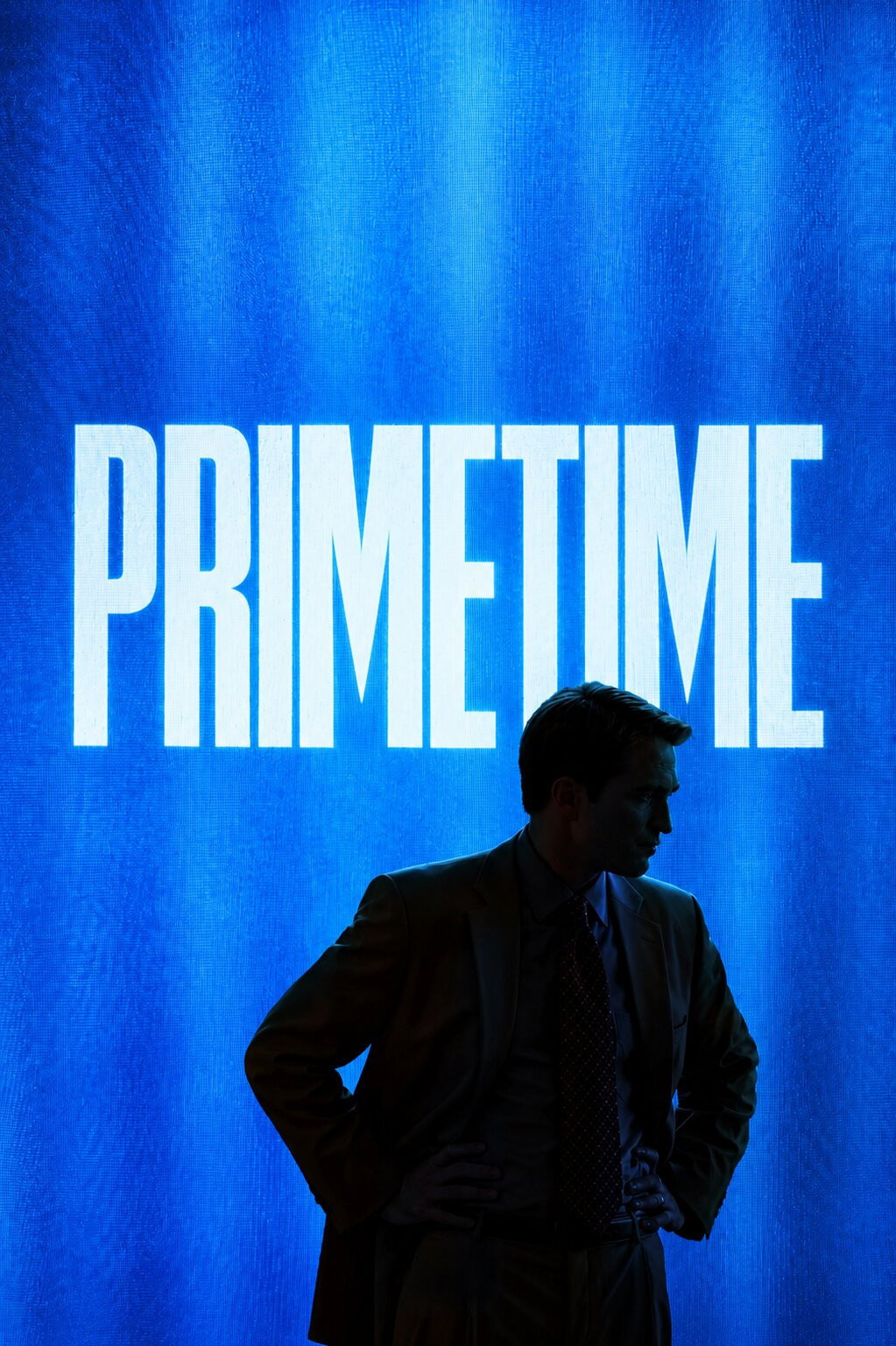
My favorite image in Primetime makes its television host look almost like Two-Face. Robert Pattinson stands inside while rain pours down outside a glass door, and the water streaming across the glass covers part of his face. It is a great way to look at a guy whose job is supposedly to show us who the bad people are. The movie has some questions about how much he enjoys that job.
That perspective, along with the style and performances, kept me entertained even when I wondered whether this story needed to become a movie. Three stars for a film with a very specific vision and a complete willingness to follow it.
Spoilers ahead.
★ Style
The best thing about Primetime is how completely it commits to its aesthetic. VHS imagery and television-era visuals are a major part of the experience. The whole thing has a griminess that suits a movie about turning other people’s worst behavior into television. I enjoyed being in that visual world, even when the underlying story felt familiar.
The shot through the wet glass captures what worked for me. Pattinson’s Chris Hansen-like host is frequently framed almost as a villain himself. He is creepy, obsessive, theatrical, and clearly gets something out of the spectacle. That image gives him a divided face while we are already trying to decide how to feel about him. It is heightened, but the movie is heightened enough to support it.
I also really liked the sequences connected to his story about India. As he tells it, the film visually takes us into the memory. For a little while, we get away from the griminess of the television production and enter the story he is describing. Those passages felt immersive and gave the movie some welcome visual variety.
They also made me appreciate that the filmmaker had more in mind than recreating the appearance of an old television show. The style can change with the material. I was interested in how a scene would be presented even when I was less interested in what happened next.
★ Theme
One recurring detail I liked is how much junk food the host eats. The man is constantly indulging himself, and it felt connected to the pleasure he takes in exposing and humiliating people. Watching him eat, I started thinking about the whole operation as another kind of consumption. There is always something else to take in.
That is my reading of it, but the movie gives the comparison plenty of room. He seems to enjoy the process more than he perhaps should. The theatricality matters because he is an entertainer, and other people’s humiliation is part of what he is serving up.
His explanation of public punishment gives that idea more substance. He talks about things like stocks, whipping, and people throwing tomatoes or rocks at someone who behaved badly. The argument is that we have kept the public punishment and changed the venue. Television becomes the town square. Put somebody onscreen, and millions of people can participate in judging them.
I liked having that argument in the movie. It gives us something to consider beyond whether the person being exposed did something wrong. There is also the host, the production, and the audience getting entertainment out of the punishment. His obvious enjoyment makes that arrangement feel stranger.
I would be careful about treating this character as a statement about the actual Chris Hansen. This is a heightened television-host archetype, and the movie deliberately makes him morally uncomfortable. I do not have to agree with every implication to appreciate the choice. The director has a clear perspective, and that perspective is much more interesting to me than simply replaying a familiar sting operation.
★ Cast
Pattinson is great. The host’s creepiness, theatricality, and enjoyment all belong in the same performance, and he makes that combination work. He fits the exaggerated world around him without making the character feel like he wandered in from another movie.
The ensemble is very good, too. The actress playing his producer, the actor playing Decoy Dan, and the actress playing the other decoy all feel fully committed to what this movie is doing. With a style this strong, that matters. Everyone seems to understand the kind of film they are in, and the performances help sustain it.
My main reservation is about the story itself. So much of the underlying material comes from a television phenomenon that already existed publicly. There were stretches where I wondered what I was gaining from seeing it fictionalized. The fact that something happened and people watched it does not, by itself, make me want a dramatization.
The visual choices and performances did more to answer that question than the plot did. They gave me a reason to keep watching even when I was unconvinced that the material needed this treatment.
Final verdict
Three stars for Style, Theme, and Cast. Primetime is enjoyable and well-made, with a strong ensemble and images that stayed with me. I never entirely shook the feeling that it was unnecessary, but I respected how fully the filmmaker committed to this particular way of seeing it. The rain across Pattinson’s face makes a better case for the movie than the premise alone does.