Blanket: what does staying close actually measure?
Nolan McDermott · NFL Big Data Bowl 2027 · October 22, 2026
Can movement through combine defensive-back drills identify cornerbacks who sustain tight coverage in NFL games? I investigate this through Blanket: a proposed man-coverage assignment with time-weighted average receiver–defender separation strictly below one yard, from snap through throw. Exactly one yard does not qualify.
Finding: the current study does not establish useful combine-to-coverage prediction. Starting alignment changes the interpretation of separation, receiver assignments remain inferred, and a promising W-drill feature is sensitive to how movement direction is measured. The contribution is an auditable test of the proposal, with a practical way to choose contrasting coverage clips for review.
Full analysis and interactive explorer · Reproduction notebook · Methods and review protocol
Measure the assignment before evaluating the player
The study joins combine and NFL records by player ID and draft year. It includes regular-season passing plays from 2023–2025 with CB/SLOT_CB alignment, team man coverage, an individual MAN assignment, and no nullified play. Three defensive-back drills provide prototype features for all 60 combine CBs; 43 have measured pairs.
Of 4777 candidate reps, 874 survive tracking and pairing checks. The procedure selects the nearest observed route runner within five yards at snap, requires a one-yard advantage over a second observed runner when present, freezes receiver identity, and rejects collisions across measured CBs. It requires synchronized snap and throw endpoints, at least one second of coverage, 90% of expected 10 Hz observations, finite positions, and no gap above 0.2 seconds. Missing tracking is excluded, not scored as failed coverage.
The denominator is measured, eligible pairs. Trapezoidal integration of simultaneous Euclidean distance, divided by elapsed time, yields average separation. There are 13 provisional Blankets (1.49%). A brief gap above one yard can coexist with a qualifying average.
The critical limitation is incomplete opponent tracking: 516 pairs have only one observed route runner at snap. The true assignment may be untracked. The five-yard screen also limits off-man representation. These results describe selected measured pairs, not all coverage or all prospects. Game distances assume yards; current-year dictionary confirmation is still pending.
Average proximity adds temporal context, not demonstrated defensive value
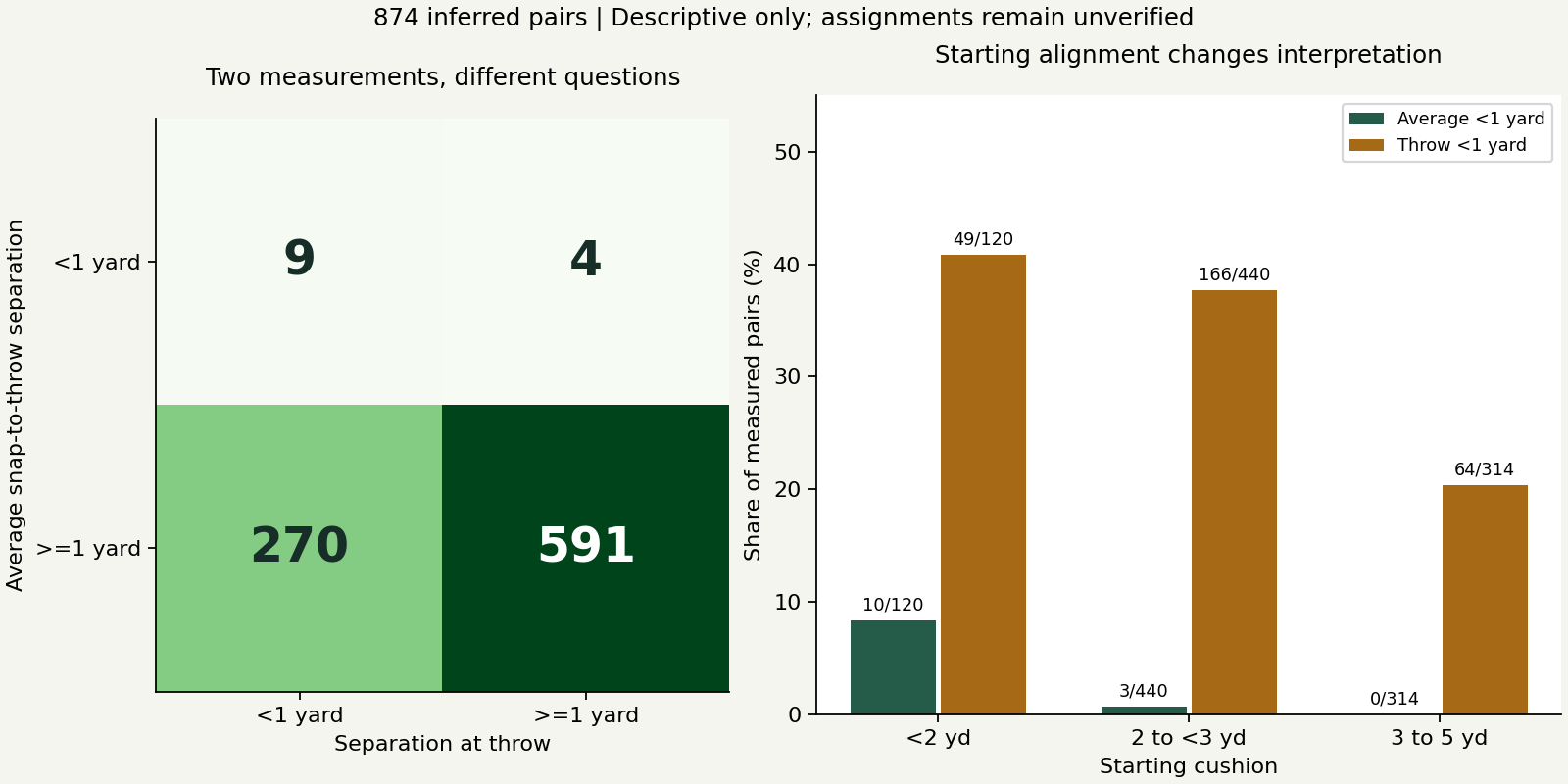
Of 279 pairs under one yard at throw, 270 do not qualify as Blankets. Four provisional Blankets finish at least one yard apart; none finishes at least two yards apart. A large late-gap failure is therefore possible mathematically but not observed among these positives. Removing the first 0.5 seconds changes the under-one-yard count from 13 to 63; this is a sensitivity comparison, not a revised Blanket definition.
Ten of the 13 positives start under two yards away. None starts three to five yards away. This cannot establish cushion’s causal effect, but it shows why a low average cannot be interpreted without the starting responsibility.
Football application: select contrasting reps for a coverage meeting. A private, fixed-seed 12-case shortlist includes four average-only tight reps, four throw-only tight reps starting at least three yards away, and four tight by both measures. First confirm responsibility from independent evidence. Then ask whether cushion explains the disagreement and whether the gap opened or closed late. The tool prioritizes film questions; target suppression, player grades, and coaching benefit have not been established.
Establish the simple baseline
All comparisons below hold out one entire CB, use the same 26 players with at least ten measured reps, and score player-average separation with equal player weight. Imputation and standardization use training players only; ridge penalty is fixed at one. The constant comparator uses the training-player median, appropriate to absolute-error scoring.
| Inputs | MAE | Available before NFL play? |
|---|---|---|
| Training-player median | 0.358 | No held-out NFL context used |
| Conventional combine only | 0.356 | No held-out NFL context used |
| Starting cushion only | 0.245 | Uses observed NFL cushion |
| Existing context baseline | 0.251 | Uses observed NFL cushion |
Starting cushion alone yields about 0.245 yards MAE, versus 0.358 for the training median and 0.356 for conventional combine measurements. Adding those conventional measurements to cushion yields about 0.251. The contextual analysis is therefore strongly influenced by information observed in NFL play. It is not a deployable pre-draft forecast, and these retrospective comparisons have no untouched final cohort or independent assignment truth.
Validate the movement before interpreting the prediction
The drill detector selects the largest moving heading change over 0.4 seconds, with 0.6 seconds of observed data on either side. Three-frame smoothing reduces noise. Speed at the turn, braking, and reacceleration are aggregated by player median across attempts. These are operational windows, not validated biomechanical phases or reaction times. Combine speed remains in source units.
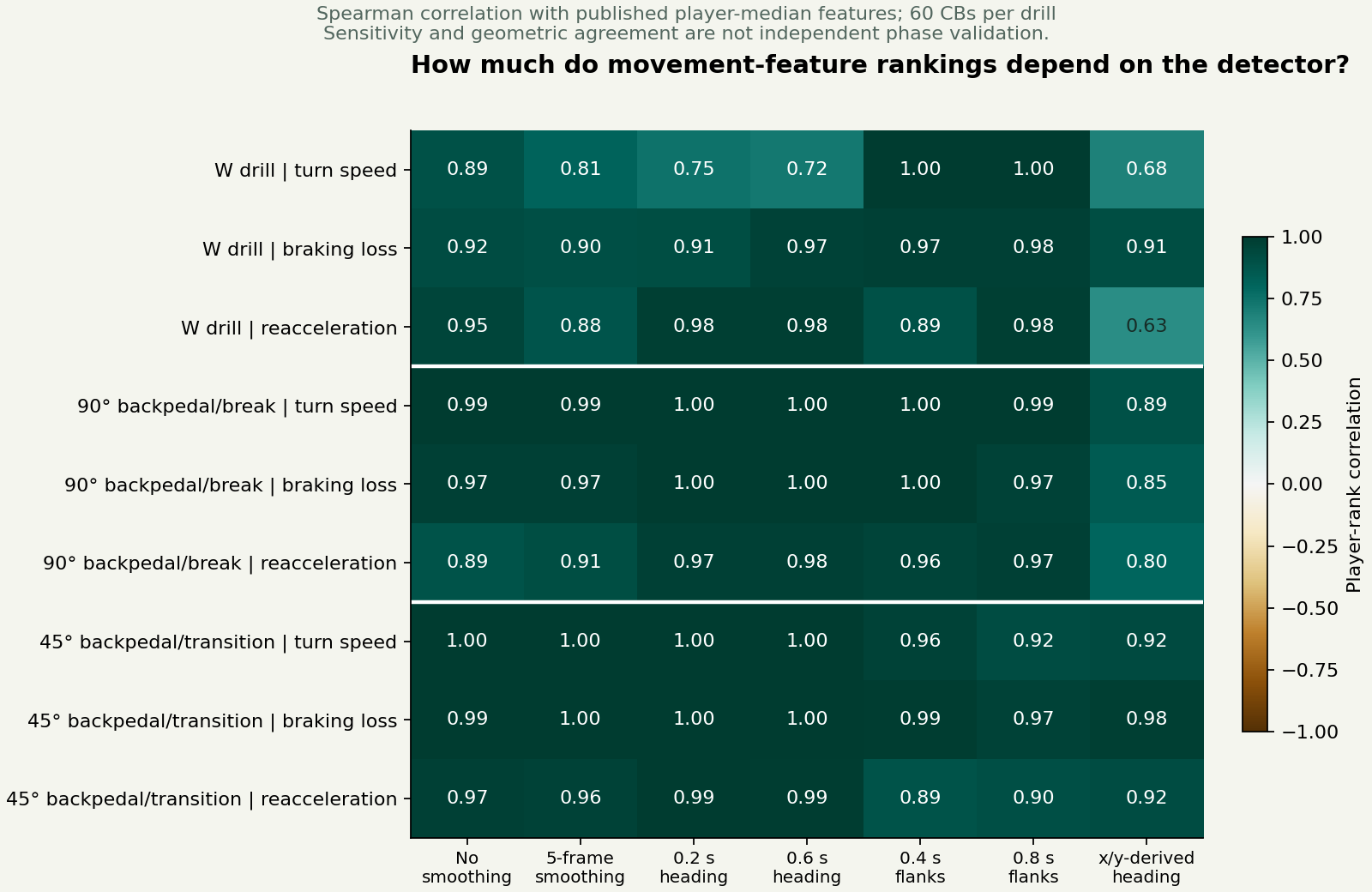
An elapsed-time implementation reproduces the published detector on this sample. Six one-setting perturbations and coordinate-derived heading test robustness without using coverage outcomes to choose settings. With coordinate-derived heading, 16 of 61 W-drill centers shift more than 0.2 seconds, and player reacceleration rankings correlate only 0.633 with the original version. The same sensor system supplies both signals, so this is geometric agreement, not independent validation. Entry speed, turn angle, and intended phase still require confirmation.
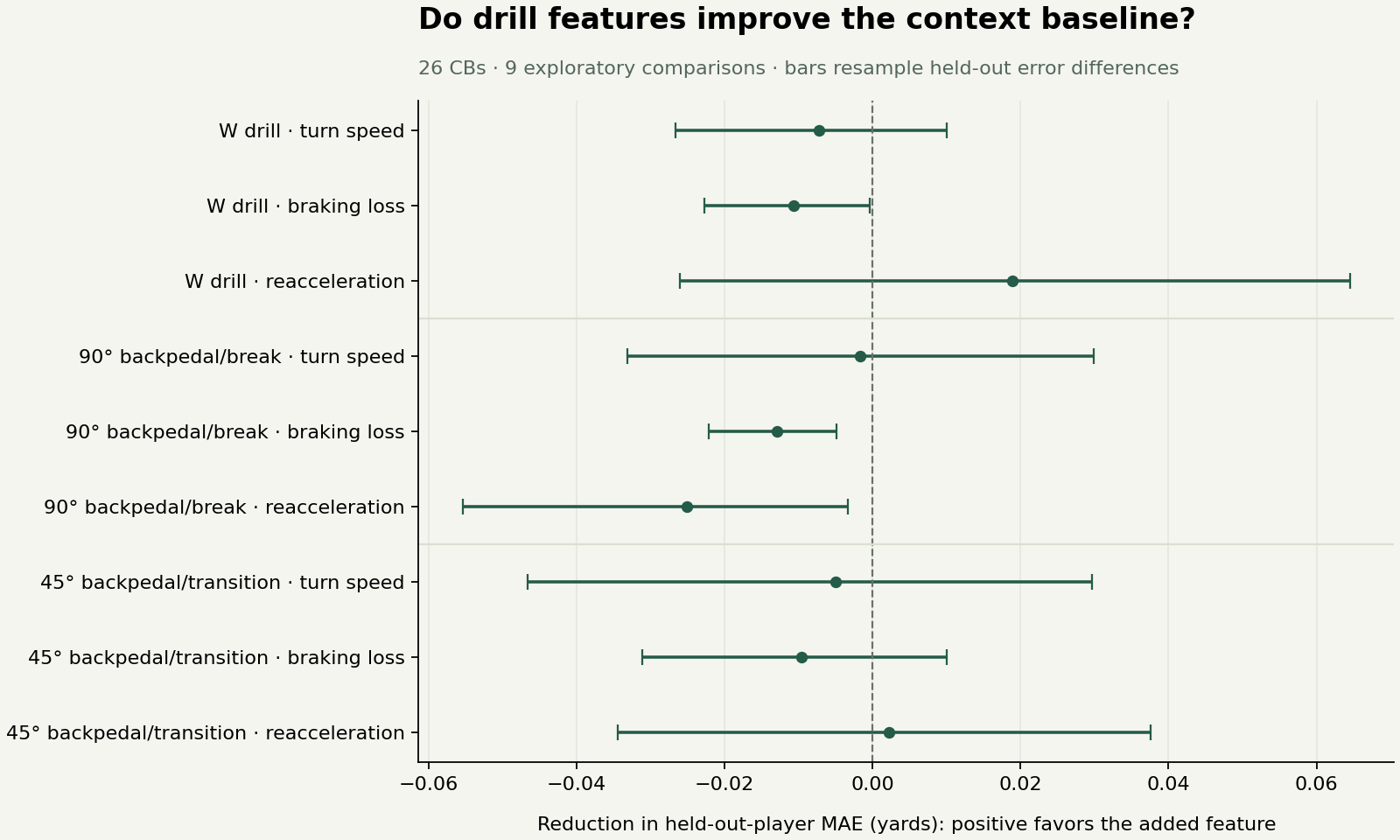
Adding W-drill reacceleration to the context baseline reduces MAE from about 0.251 to 0.232 yards. Its 95% error-resampling range for improvement is −0.026 to 0.065 yards, including worsening. These 2,000 paired resamples keep predictions fixed; they omit full training uncertainty, overlapping-fold dependence, multiple comparisons, and assignment error. The small apparent gain is insufficient to establish translation of a combine trait to coverage skill.
What is trustworthy now, and what would change the conclusion?
The arithmetic, eligibility checks, denominator reconciliation, and measured sensitivity are reproducible. Independent receiver assignments and physical drill-phase identity are not verified. The ZIP contains nine CSVs, no video, and no explicit assigned-receiver ID. The review workflow freezes 80 outcome-masked random pairs, separately includes every positive, and prepares 18 random drill attempts for independent source annotation. All remain pending. Tracking-only visual review must not be substituted for that evidence.
Evidence needed next is specific: source-backed receiver responsibilities, independently annotated drill boundaries, comparable entry-speed/turn-angle tasks, route and receiver context, and genuinely new evaluation data. A new split of already inspected outcomes would not restore an untouched test set.
Blanket currently supplies a transparent description of sustained proximity and a clip-selection question. Whether that description improves player evaluation beyond simpler measurements remains an open empirical question.
Data: NFL / Next Gen Stats, via the official competition. This is a research brief and reproduction package, not a claim of completed Kaggle submission or verified player rankings.